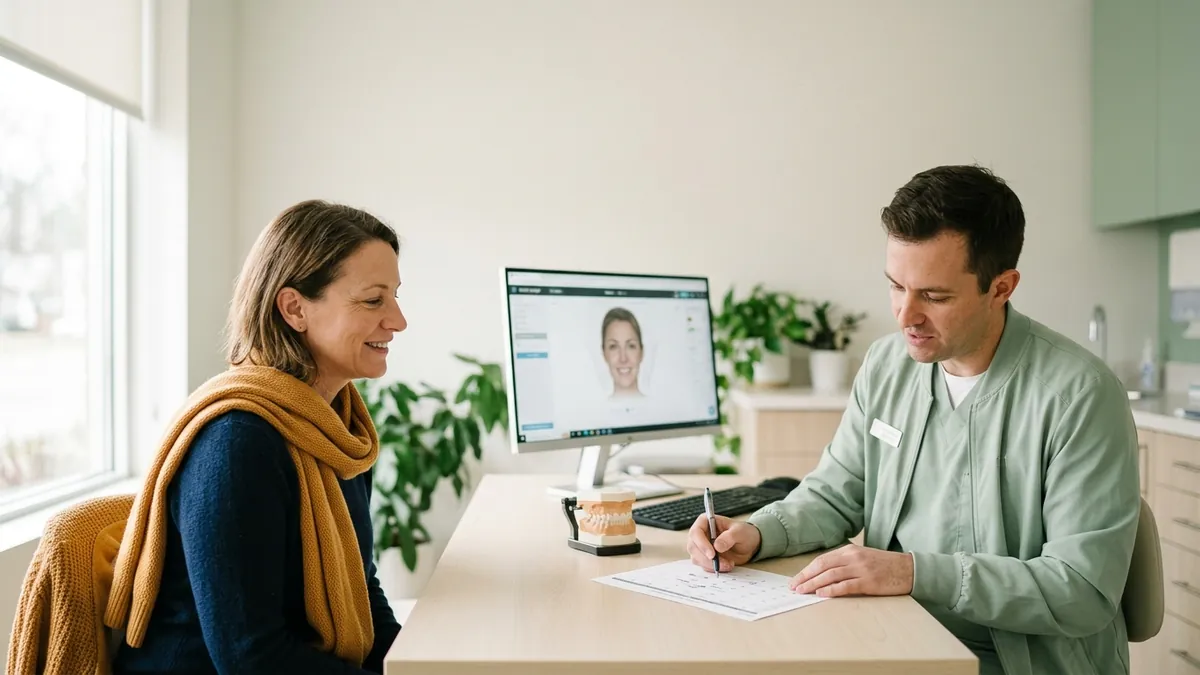
Six to seven days on the ground, across two clinic appointments. The lab work in between sets the pace, and it is the reason the trip cannot sensibly be compressed into three days no matter what anyone promises.
Published 2026-01-22 · Reviewed with clinic surgeons
What a Hollywood Smile actually is
It is not a specific procedure. It is a plan: every tooth visible when you smile — usually twenty, sometimes twenty-eight for a wide smile — is restored as part of one design. Shape, length, proportion and shade are decided across the whole arch rather than tooth by tooth.
Most cases use zirconia or E-max crowns. Some use veneers where the underlying teeth are healthy enough. A growing number use full-mouth composite bonding, which achieves much of the same result without preparing the teeth at all.
Day by day
Day 1 — consultation and design. Photographs, an intraoral scan and often a facial scan. The new smile is designed on screen and you approve the shape before anything is touched. Expect two to three hours.
Day 2 — preparation and temporaries. Each tooth is reduced to make room for its restoration, then a provisional set matching the approved design is fitted the same day. Four to six hours in the chair.
Days 3–5 — the lab works. Your only job is to wear the temporaries and pay attention. This is the test drive.
Day 6 — try-in. Finals are tried without cement to check shade, fit and contact points. Adjustments go back to the lab if needed.
Day 7 — fitting. Bite refined and restorations cemented or bonded.
The temporaries are the most important days
Most patients treat the provisional phase as dead time. It is the opposite. Temporaries are a physical prototype of the final result, and it is far easier to change something at this stage than after twenty crowns have been made.
Speak with them in. Say words with S and F sounds — if the edges are too long you will hear it before you see it. Eat with them. Photograph yourself in daylight, not clinic lighting, which flatters everything. If the teeth feel too long, too square, or too white, say so on day three, not day seven.
Why it cannot be done in three days
The restorations have to be designed, milled or pressed, then stained and glazed, with firing cycles between stages. A clinic with its own on-site laboratory can complete twenty units in three to four days. One that outsources to an external lab needs seven to ten.
If a clinic offers a complete Hollywood Smile in three days, one of two things is happening: the case is smaller than a true full smile, or the lab is rushing stages that determine how the result looks and how long it lasts.
What it costs
Featured clinics in Türkiye quote $3,200 to $5,400 for a full Hollywood Smile of twenty to twenty-eight units. The range reflects the number of teeth and the material chosen.
The comparable figure in the United States is typically $30,000 to $40,000 for the same number of units. The materials are the same; what differs is the cost of the room, staff and insurance around them.
Before you commit
A Hollywood Smile is irreversible when done with crowns. Healthy enamel is removed and cannot be replaced. If only a few teeth genuinely bother you, veneers or bonding will preserve far more of your own tooth structure.
Whitening comes first, always. Crowns and veneers do not lighten later, so the target shade has to be settled before anything is made.
Ask to see the clinic's own before-and-after cases photographed under consistent lighting and angles. Inconsistent case photography is a reliable sign that the good results are being selected and the rest are not being shown.
Common questions
Usually twenty for the visible smile zone. Wider smiles that show more teeth may need twenty-four to twenty-eight units for a consistent result.
Preparation is done under local anaesthetic and is not painful. Expect gum tenderness and sensitivity to hot and cold for one to two weeks afterwards.
Ten to fifteen years for well-made crowns or veneers with good hygiene. Gum recession over time can expose margins, which is usually what prompts replacement rather than the restorations failing.
Yes. Most clinics prefer a same-city night after final cementation so any bite adjustment can be made before you travel.